
Charting Malaysia’s 5G Performance as the Country Transitions to a Dual 5G Network Model
Malaysia successfully deployed its 5G network using a unique Multi-Operator Core Network (MOCN) model, with several major providers operating on a single 5G network overseen by Digital Nasional Berhad (DNB). This strategic approach has yielded significant initial outcomes, including high median 5G speeds and extensive population coverage. This report analyzes Malaysia’s current 5G landscape and its impact on the user experience as the country shifts toward a Dual Network (DN) strategy, which aims to introduce competition and meet the growing capacity demands of a maturing 5G market.
Key Takeaways
- Malaysia’s unique 5G deployment model, overseen by DNB, has achieved high population coverage and high initial median 5G speeds, but performance has since shown a downward trend. The median download speed for all providers combined decreased from 451.79 Mbps in Q4 2023 to 242.92 Mbps by Q3 2025. This decline coincided with an increase in 5G device adoption and contrasts with speed stability observed in comparable multi-operator markets in neighboring countries.
- Malaysia is experiencing an increase in 5G-capable device adoption, indicating an expanding 5G-ready subscriber base. Based on Speedtest Intelligence® data, the proportion of all tests conducted on 5G-capable devices jumped from 58.6% in Q4 2023 to 79.5% in Q3 2025, with those connected to a 5G network making up 55.0% of all test samples in Q3 2025.
- Despite high consumer readiness for 5G adoption, maximizing the technology’s potential faces challenges, as 5G-capable devices spend 65.8% of their connected time on 4G networks. This gap is primarily driven by persistent coverage issues, particularly the lack of ubiquitous indoor 5G coverage and inconsistent service in rural areas.
- Controlled testing shows Digital Nasional Berhad’s (DNB) existing 5G network currently provides the dominant 5G coverage in the Klang Valley, forming the essential footprint for all operators’ 5G coverage. Speedtest Drive™ controlled network testing showed U Mobile, the second 5G network provider, still primarily camped on DNB’s frequencies (83.2% of test samples) despite its own active network deployment. In comparison, Yes, acting as a proxy for DNB’s 5G network coverage, camped on DNB’s 3500 MHz mid-band frequency in 77.9% of test samples.
Malaysia’s unique 5G model performance trending downwards while neighbouring countries hold steady
Malaysia’s 5G network performance declined from Q4 2023 to Q3 2025, a trend that directly contrasts with the stable or relatively improving performance seen in several neighboring markets. This decrease followed an initial high benchmark; our previous report noted Malaysia’s 5G median download speed as one of the world’s top performers, ranking third globally in Q3 2023. The median 5G download speed subsequently declined from 451.79 Mbps in Q4 2023 to 242.92 Mbps in Q3 2025. Over the same period, the median 5G upload speed also decreased, falling from 49.87 Mbps in Q4 2023 to 29.52 Mbps.
5G Performance Trend Across Selected Markets in Asia Pacific
Speedtest Intelligence® | Q4 2023 – Q3 2025
Up until early 2025, Malaysia deployed its 5G network using a distinct Multi-Operator Core Network (MOCN) architecture through DNB, a government-owned entity. This approach aimed to accelerate national coverage and optimize infrastructure investment. The subsequent speed decline suggests network maturation, as the focus shifted from initial high-speed urban deployment to wider geographic coverage. This expansion led to increased user adoption and usage, which placed higher demands on network capacity. Furthermore, as user adoption of 5G increases, the demand for high-capacity applications like streaming and IoT devices rises, driving the need for more assigned spectrum bandwidth to maintain and improve network performance, speed, and reliability. By channeling all operators’ 5G radio traffic through a single provider, the network is subject to speed degradation when demand rapidly increases across the entire infrastructure.
This contrasts with regional peers operating under multi-operator frameworks where market competition and segmented spectrum allocation may offer better resilience and capacity planning against traffic surges. South Korea, a long-established 5G leader, consistently reports median 5G download speeds above 528 Mbps, peaking at 564.14 Mbps by Q3 2025. Singapore demonstrates stability, with speeds reaching 349.19 Mbps in Q3 2025. Conversely, Vietnam and Brunei showed significant increases. Vietnam’s median 5G download speed reached 350.28 Mbps in Q3 2025, and Brunei also showed an overall upward trend despite some fluctuation. The observed increase in 5G performance in Vietnam and Brunei is likely attributable to their status as newer 5G markets, where initial deployments cater to a smaller, less congested subscriber base. This initial strong performance should stabilize as adoption increases in these countries.
Despite the decline, Malaysia’s Q3 2025 download speed remains competitive with several neighboring markets, notably outperforming the Philippines (120.16 Mbps), Japan (124.11 Mbps), and Thailand (169.35 Mbps), the latter of which operates predominantly on low-band and lower-mid frequency bands, naturally limiting peak speeds compared to regional peers.
Malaysia sees significant 5G-capable device adoption growth
Based on GSMA Intelligence data, 5G accounts for almost 40% of consumer connections in Malaysia, while 4G makes up nearly 60%. Analysis of the data on the proportion of devices taking Speedtests in Malaysia clearly indicates the significant growth in 5G-capable device adoption over the period from Q4 2023 to Q3 2025 . The rising proportion of users conducting Speedtests on 5G-capable devices suggests the 5G subscriber base is expanding, driven by greater device compatibility and compelling operator 5G service offerings.
Proportion of Devices Taking Speedtest in Malaysia
Speedtest Intelligence® | Q4 2024 – Q3 2025
According to Speedtest Intelligence® data, 79.5% of all tests conducted in Malaysia in Q3 2025 were carried out on 5G-capable devices. This total includes 55.0% of tests connected directly to a 5G network and 24.5% conducted by 5G-capable devices using non-5G networks. This marks a significant increase from Q4 2023, when 5G-capable devices accounted for 58.6% of all tests, with only 35.4% connected to the 5G network.
Despite the growth, users spend majority of their connected time on 4G network
Despite the growing number of 5G-capable devices, data from Q3 2025 shows that users on 5G-capable devices still spend the majority of their connected time on the 4G network. For all 5G-capable devices, 65.8% of their connected time is spent on the 4G network, compared with 29.8% on 5G.
This heavy reliance on 4G is strongly linked to two key factors. The first is the lack of comprehensive 5G indoor coverage nationwide. 5G typically relies on high-frequency bands, which penetrate walls and building materials less effectively, even though an estimated 70% to 80% of all mobile usage occurs indoors. DNB actively addresses this constraint by deploying 5G In-Building Solutions (IBS) at high-footfall sites. As of January 2025, DNB installed 5G IBS at 73 strategic sites, including major airports, hospitals, and transportation hubs.
Second, while DNB achieved its 80% coverage of populated areas (COPA) mandate, with recent reports stating coverage is around 82.4%, 5G service remains intermittent in many rural and non-urban areas. In our previous report, we analyzed how more rural states in Malaysia reported lower 5G Availability. This indicates that infrastructure deployment in these states often targets only the state’s capital city and major towns. The lower density of sites outside these major hubs forces devices to fall back to the 4G network, contributing to the higher time spent on the older technology
Transitioning to a dual 5G network to drive the next phase of competition
Malaysia is currently transitioning from its initial 5G network deployment model, operated by DNB, to a Dual Network (DN) approach. This policy shift marks a significant turning point in the country’s telecommunications strategy, moving away from a government-led monopoly structure toward one based on competition. The government mandated that the transition would begin once DNB achieved 80% coverage of populated areas (COPA), a target DNB hit by the end of December 2023.
In November 2024, the government announced U Mobile, the country’s third-largest mobile network operator, as the selected provider to implement the second 5G network provider. In March 2025, U Mobile stated that it had begun rolling out 5G service using standalone access (SA) technology to customers in stages. U Mobile aims for 80% coverage in populated areas within the first year of operation and 95% by the third year. DNB will continue to deploy and operate its network in parallel with U Mobile’s rollout. Managing the transition requires addressing complex considerations, including spectrum allocation for the second network, DNB’s financial viability, and the efficient operation of two parallel 5G networks.
Controlled testing shows DNB’s established network currently provides the dominant, most available 5G footprint
DNB, the incumbent 5G network provider, retained its initial spectrum allocation (F1) across the 700 MHz, 3.5 GHz, and 28 GHz bands. U Mobile, conversely, received specific blocks (F2) for the second 5G network rollout in the 700 MHz and 3.5 GHz bands.
To assess the end-user’s real-world 5G mobile experience under this structure, Ookla® used the Speedtest Drive™ controlled network testing methodology in October 2025. The testing focused on five primary clusters within the Klang Valley—Bukit Bintang, Bukit Jalil, Sunway Damansara, Tasik Batu, and Setia Alam. The controlled testing team was equipped with the latest 5G-capable handsets featuring SIM cards from major operators in the country. Among the five operators included, both Yes and U Mobile are currently implementing 5G Standalone (5G SA) technology. Yes delivers 5G SA services via the DNB infrastructure, integrating its own 5G Core. In contrast, U Mobile employs a dual strategy: it leverages the DNB network for base coverage while rapidly deploying its own second 5G network, which is fully 5G SA by design.
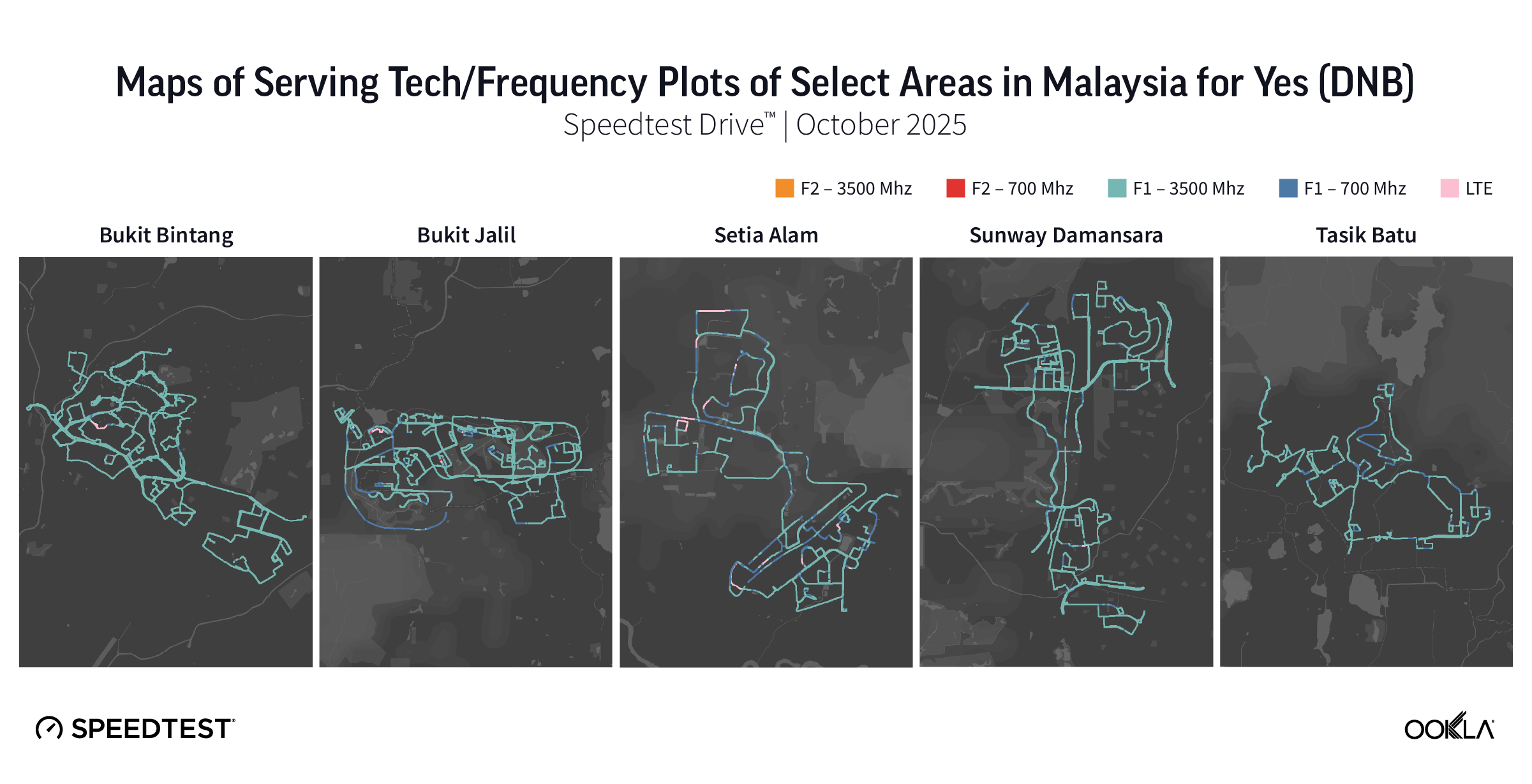
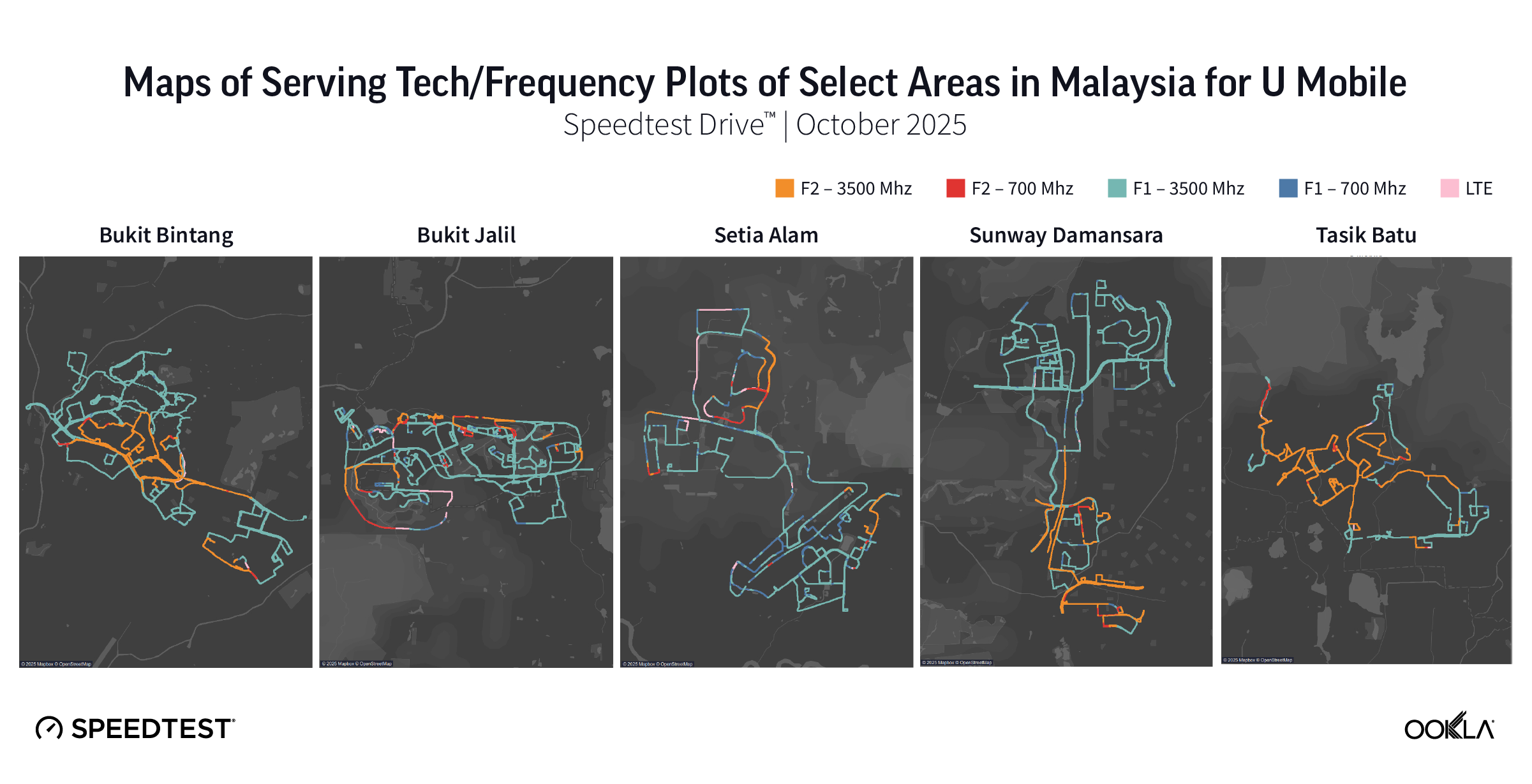
Using Yes as a proxy for DNB’s 5G network coverage along the data collection routes, the controlled network testing results provide unique insight into the network coverage comparison between the two 5G network providers. Analysis of the combined data across all clusters reveals that DNB’s established mid-band 3500 MHz spectrum (F1) provides the dominant 5G SA coverage footprint, effectively acting as the essential anchor for all service providers. The data from U Mobile SIMs showed they camped on DNB’s frequency bands for a combined 83.2% of the test samples. The DNB-managed 3500 MHz spectrum (F1) accounted for the largest share at 67.9%. Conversely, the U Mobile SIM camped on its own network for only 16.8% of test samples, despite U Mobile actively deploying this infrastructure . In comparison, 77.9% of Yes’s test samples camped on DNB’s 3500 MHz band.
As Malaysia’s telecom market transitions to a Dual Network model, we will continue to track its progress. This shift is anticipated to foster competition, leading to a more resilient and performance-driven 5G experience for consumers. For more information about Speedtest Intelligence data and insights, please contact us.
Ookla retains ownership of this article including all of the intellectual property rights, data, content graphs and analysis. This article may not be quoted, reproduced, distributed or published for any commercial purpose without prior consent. Members of the press and others using the findings in this article for non-commercial purposes are welcome to publicly share and link to report information with attribution to Ookla.