
Oman’s Path Toward Faster, More Accessible, and Resilient 5G Services
Oman is one of the most dynamic mobile markets in the Gulf region, with three mobile operators, Omantel, Ooredoo, and Vodafone, and two MVNOs, Friendi and Renna. Increased competition and infrastructure investments, combined with the refarming of 3G spectrum, helped Oman lift its position in Ookla’s Speedtest Global Index™ in 2025. This article shares insights about the mobile performance evolution of the three operators, discusses the drivers for its improvement, and assesses the country’s network resilience during the Red Sea cable cut in September 2025.
Key Takeaways:
- Oman’s regulatory strategies drove competition and 5G expansion. The infrastructure sharing policies of the Telecommunications Regulatory Authority (TRA) that supported the entry of a third mobile operator, Vodafone, in 2022, combined with mid- and low-band spectrum allocation and the mandated 3G network sunset roadmap, contributed to the rapid expansion of 5G population coverage (reaching 91% in 2024).
- Increased investment and network improvements led to a rise in Oman’s ranking in Ookla’s Speedtest Global Index. Operator investments grew significantly between 2021 and 2025, expanding the 5G site count to 6,671 by mid-2025. These investments, alongside the competitive and regulatory environment, resulted in all-technologies’ median download speed more than doubling to 121.84 Mbps by the end of 2025, while 5G download speed reached 259.94 Mbps. Consequently, Oman climbed five positions to the 18th spot in the Index in 2025.
- Omantel and Ooredoo maintain a significant performance lead over Vodafone in 5G download speeds. This advantage is attributed to the greater spectrum holdings of the two incumbent operators, particularly in the mid-band (3.3-4.2 GHz) for 5G, and ongoing substantial infrastructure investments. On the other hand, Vodafone’s limited spectrum assets appear to be constraining its download speeds, while its upload speeds are more competitive thanks to its use of 700 MHz FDD spectrum band.
- Oman’s geo-redundant international connectivity strategy provided superior resilience during the September 2025 Red Sea cable cuts compared to neighboring Gulf countries like the UAE. Oman leverages over 20 subsea cables and terrestrial links, allowing operators to reroute traffic and mitigate against impacts to online service quality, evidenced by only a small increase in gaming latency and web loading time during the outage.
Competition has been driving network investment and has contributed to improving the network experience for users in Oman
Vodafone’s entry into a saturated mobile telecom market in Oman in March 2022 has significantly reshaped the competitive landscape, long dominated by Ooredoo and Omantel. It created an impetus for further growth, leading to a jump in the number of mobile subscribers to over 6.6 million in Q2 2025, up from 5.7 million in Q1 2022, corresponding to a mobile penetration of 125.5%. Note that the drop in population penetration at the end of 2024 is due to adjustments to the government’s population figure.
Mobile subscribers and population penetration, Oman
Source: TRA | Q1 2022 – Q2 2025
Vodafone’s competitive pricing and digital-first strategy helped it to rapidly expand its market share within 3 years to reach 16% by the end of June 2025. MVNOs, Renna and Friendi (piggybacking on the network of Omantel and Vodafone, respectively), also control a sizable share of the market at 19% by targeting the youth and expat segments, respectively. That said, Omantel and Ooredoo, which share a similar market share, continue to control the majority of the market in terms of subscribers.
Mobile Subscribers’ Market Shares, by Operator, Oman
Source: TRA | H2 2023 – H1 2025
5G was launched in late 2019, initially to provide fixed-wireless access (FWA) services, before enabling 5G mobile services in 2021. Market players have been increasing their mobile infrastructure capex since, growing from OMR 87.1 million ($226.1 million) in 2021 to OMR 124.3 million ($323.0 million) in 2024, according to the TRA. This helped to expand the 5G network from 1,587 sites with population coverage of 44.9% in 2021 to 5,893 sites with population coverage of 91% in 2024. By comparison, 5G population coverage reached 99% in Qatar and the UAE, according to regulatory and operators’ sources. This is quite an achievement considering that Oman has a larger land mass and more challenging terrain to deploy telecom infrastructure.
These investments enhanced broadband services for consumers and businesses, providing higher download and upload speeds. According to Speedtest Intelligence® data, the 5G median download speed experienced by end users in Oman rose from 191.03 Mbps in Q4 2022 to 259.94 Mbps in Q4 2025. During that period, the median speed for all technologies saw more impressive improvements, more than doubling and reaching 121.84 Mbps by the end of 2025. As a result, Oman moved up to the 18th position in the Speedtest Global Index by five places between January and December 2025.
All Technologies and 5G Median Download Speed, Oman
Source: Speedtest Intelligence® | Q2 2022 – Q4 2024
Regulatory decisions have played a role in boosting 5G coverage and enhancing network performance.
The TRA initiated a network sunset roadmap for 3G, freeing valuable spectrum for 4G and 5G, and encouraging infrastructure sharing, which was instrumental in lowering the barrier to entry for the third operator, Vodafone.
Omantel and Ooredoo were allocated a 100 MHz block each in the prime mid-band spectrum (3.4 – 3.7 GHz) in 2019 to launch 5G services. This band is critical because it offers an optimal balance between coverage and capacity (up to gigabit speeds), and benefits from wide smartphone support. Finally, TRA allocated 26 GHz spectrum (mmWave) in March 2024, to be used for 5G and future 6G trials, while exempting operators from spectrum fees during the experimentation period.
A cornerstone of the TRA’s strategy to improve network performance and spectral efficiency was the mandated retirement of legacy 3G infrastructure. By decommissioning 3G, the TRA allows operators to refarm valuable low-band spectrum (typically 900 MHz and 2100 MHz) for 4G and 5G use, which provides far greater data capacity per MHz of spectrum.
The TRA coordinated a phased regional shutdown of 3G, from low-density areas to the capital, to minimize consumer disruption. The process was largely completed by mid-2025. That said, the TRA maintained legacy service on a few stations near Muscat International Airport to comply with specific aviation or legacy system requirements.
As part of the 3G network sunset, more than 5,600 base stations were deactivated or upgraded nationwide. The TRA also halted the import of mobile devices that did not support at least 4G and VoLTE, ensuring that consumers maintain voice and data access once the 3G network is shut down.
The regulator also mandated the “sale and leaseback” and the sharing of passive infrastructure, such as towers, to reduce capex and encourage investment in active equipment. (e.g., radio network, core network). To this end, it established Oman Tower Company (OTC) in 2018 to acquire existing structures from operators, and build and operate new ones in order to lease them back to the operators. The primary beneficiary of this policy was the third mobile operator, Vodafone, which launched commercial operations rapidly in 2022 and focused its investment capital on active equipment and customer acquisition. In addition to the creation of OTC, the TRA mandates that dominant operators must share their passive infrastructure with other licensed players on reasonable and fair terms.
Omantel and Ooredoo lead in 5G network performance thanks to their spectrum assets and massive investments
Omantel was the first to launch 5G mobile services in February 2021. It deployed nearly 2,300 5G sites and 3,800 4G sites by the end of 2024, having trialed 5G Advanced (5.5G) and activated a second 5G carrier, 100 MHz on 2.5 GHz, in 2024. Omantel allocated OMR 80.9 million ($210.21 million) in 2024 to its network, primarily tied to 5G rollout and 4G network expansion, achieving 92% population coverage and 98% for 4G.
Ooredoo introduced 5G mobile services in April 2021. The company focused its investments in 2024 and 2025 to close the 5G coverage gap, and dedicated 84% of its OMR 38 million ($98.75 million) CAPEX in the first nine months of 2025 to network expansion. As a result, 5G population coverage increased from 79% in 2024 to 97% in September 2025. In addition, it boosted capacity on existing sites with high demand, especially to support fixed wireless access services.
The entry of Vodafone forced the incumbents to accelerate their own investment plans to defend their market share. Vodafone adopted an asset-light business model, facilitating services’ rapid deployment and minimizing capital expenditures. For example, it initially leased tower capacity from Oman Tower Company (OTC) for its 5G network and roamed over Ooredoo’s network for 4G services while it was building its own coverage. By May 2025, it deployed a cloud-based 5G network powered by more than 2,572 5G sites, achieved over 98% population coverage, and reached one million users connected to its 5G network. Its cloud-native 5G core paves the way for a future commercial 5G standalone (SA) deployment.
Strategic spectrum allocation, activation of new carriers, combined with infrastructure investments, helps Omantel and Ooredoo to defend their market position and outperform Vodafone in terms of network speeds. Both operators benefit from wider bandwidth allocations for 5G compared to Vodafone: the two incumbents had access to 100 MHz on 3.3-4.2 GHz carriers for 5G; Omantel has a further 100 MHz on a 2.5 GHz carrier (but less used than the C-band), while Vodafone opted to use only 40 MHz on the 2.5 GHz band and 10 MHz on the 700 MHz band, dynamically shared (with DSS) between LTE and 5G.
Spectrum dedicated to 4G services also impacts 5G performance since the latter is deployed in 5G non-Standalone (NSA) mode in Oman, meaning that the core network is still 4G and acts as the anchor carrier. Ookla Speedtest data, illustrated in the chart below, shows that Omantel and Ooredoo hold more diversified spectrum bands and wider bandwidth for each of them compared to Vodafone. Note that the data presented in this chart is based on samples from Android-based handsets and that “Max Bandwidth” refers to the maximum bandwidth reported by handsets, per carrier within the band
Ookla data also shows that Omantel’s 4G users are heavily concentrated in the 1800 MHz primary band, while 800 MHz is the second most frequently used primary carrier. Ooredoo’s 4G users are more well-distributed across different spectrum assets, spread mostly between 1800 MHz, 2100 MHz, and 800 MHz. Finally, Vodafone’s 4G user distribution is more concentrated in the 1800 MHz carrier, while fewer users camp on the 900 MHz and 700 MHz bands. Note that Omantel’s 35 MHz bandwidth in the 1800 MHz band is split between 2 carriers: 20 MHz and 15 MHz.
Ookla data also reveals operators are exploring the use of new spectrum bands for 5G. For example, Omantel is considering 900 MHz and 2100 MHz bands, while Ooredoo is testing 1800 MHz and 800 MHz bands. It has also activated 80 MHz in the 2300 MHz band in the summer of 2025 (see image below). Access to additional spectrum bands provides the operators with faster speeds, increased capacity, wider coverage, and lower latency. Specifically, access to low-band, sub-GHz spectrum improves session continuity and provides wider coverage, and when aggregated with mid-band spectrum, allows increased download capacity.
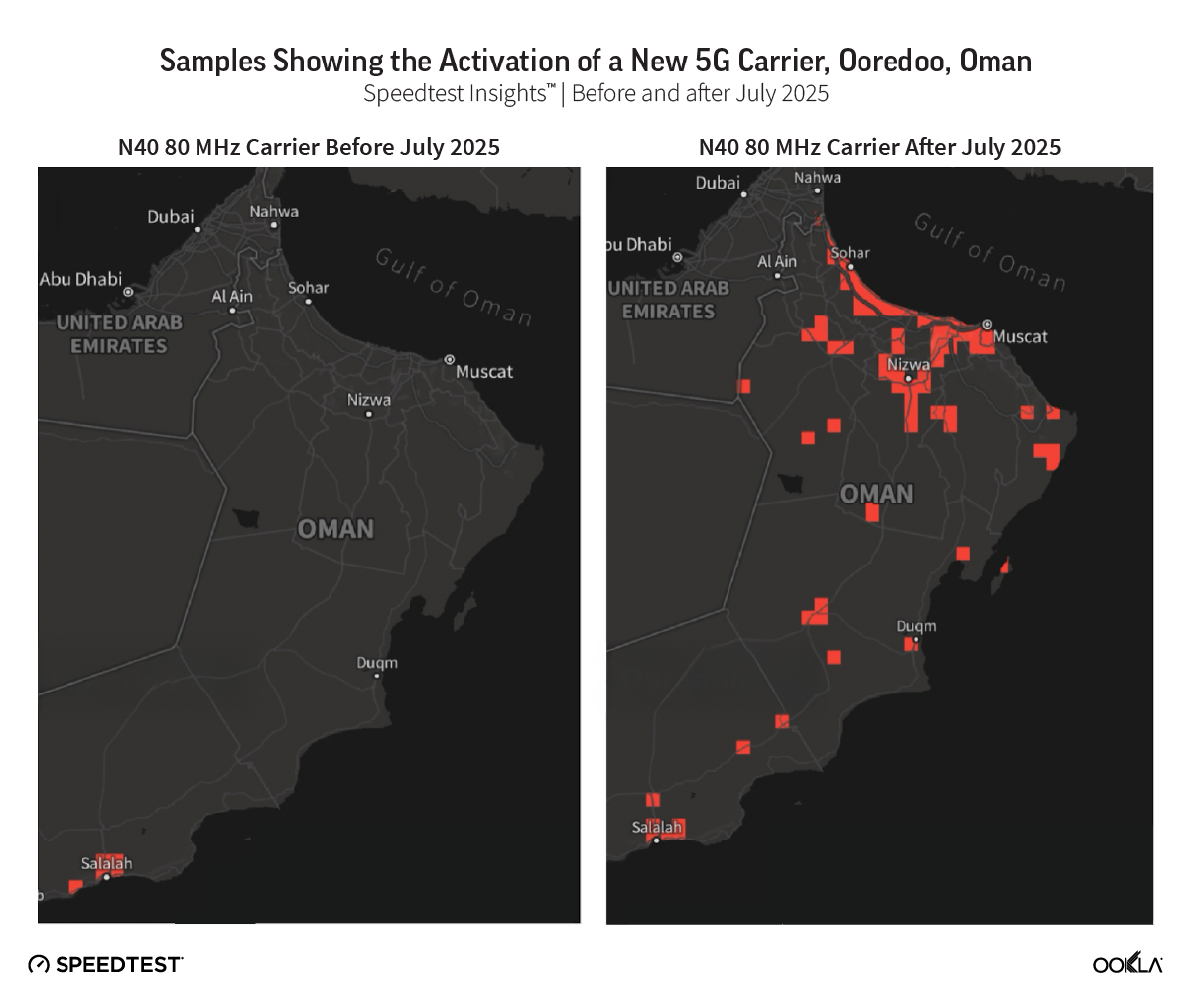
Ookla Speedtest Intelligence data show that 5G median download speeds for both Omantel and Ooredoo have been trending up since Q3 2023, to reach 323.41 Mbps and 321.67 Mbps, respectively, in Q4 2025. Ooredoo’s jump in performance in the last two quarters of 2025 is likely the result of the activation of 80 MHz in the second carrier of the 2300 MHz.
During that period, Vodafone’s median 5G download speed slightly declined to 87.9 Mbps, reflecting the more limited spectrum bandwidth forcing traffic to be equally split between 700 MHz (as the coverage layer) and 2.5 GHz (the capacity layer), in addition to growing demand on its network. The results for 5G upload speeds are more convergent with Vodafone, Ooredoo, and Omantel achieving 24.98 Mbps, 24.96 Mbps, and 20.84 Mbps, respectively, in Q4 2025, after leading the market in this area before.
5G Median Download and Upload Speeds, Per Operator, Oman
Source: Speedtest Intelligence® | Q2 2022 – Q4 2024
Oman’s network resilience: mitigating the Red Sea cable crisis
The Omani government is committed to expanding the digital infrastructure in the country as part of the country’s “Vision 2040” to drive innovation, economic diversification, and improve public services. As part of its strategy, Oman aims to consolidate its position as a regional hub for international connectivity.
Oman successfully leveraged its unique geographical location to offer unmatched route diversity and wholesale connectivity dominance in the region. By facing both the Arabian Sea and the Indian Ocean, Oman can establish different traffic routes between Asia in the East, and Africa and Europe in the West.
Zain Omantel International (ZOI), a joint venture that combines the international wholesale assets of Omantel and Zain, played an important role in ensuring that the outage had a limited impact on Omani internet users. ZOI operates more than 20 terrestrial and subsea cables that land in Oman. This multiplicity of traffic routes has resulted in better resilience for local operators compared to some of their peers in the Gulf region, particularly in the UAE. This was evidenced during the recent cuts in the subsea cables across the Red Sea on September 6th, 2025, which took offline two main cables, SMW4 and IMEWE, near Jeddah (Saudi Arabia), disrupting connectivity across the Middle East, South Asia, and Africa.
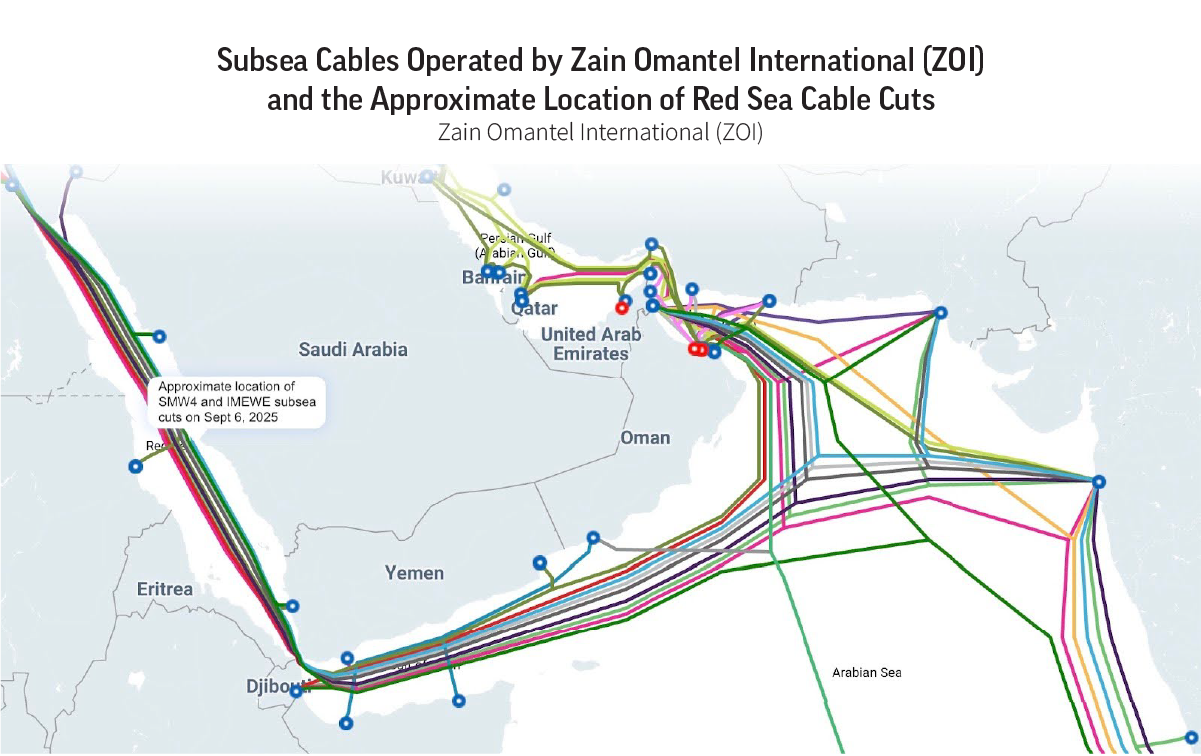
Operators in the region, including ZOI, are considering deploying terrestrial and hybrid (subsea and terrestrial) cables. Although terrestrial routes are more expensive to deploy per kilometer compared to submarine cables, they are more resilient and could offer shorter routes. For example, ZOI announced a partnership with Telecom Egypt to establish a new route that combines terrestrial (via Saudi Arabia) and subsea segments. A terrestrial fiber optic project called SONIC (Saudi Omani Network Infrastructure Corridor) is being built by stc (Saudi) and Ooredoo (Oman), planned for completion in 2026. ZOI is also building an 8,000 km terrestrial fiber network connecting Saudi Arabia with all neighboring countries, including Oman.
Another integrated subsea and terrestrial network is planned across 8 MENA countries, including Jordan, Oman, and Saudi Arabia, TEAS (Trans Europe Asia System). Once operational, it will be available on an open access model with a choice of vendors and local operators at its landing stations. These projects will complement existing subsea cables by bypassing the Red Sea altogether and reinforce the country’s position as a digital hub.
Consumer QoE data from Ookla shows the negative impact of this outage on the response time of web browsing and gaming services, particularly for UAE users, as traffic had to be rerouted via non-optimal and longer paths. In contrast, users in Oman saw only a small increase in latency during the same period. For example, web loading time jumped from 2.14 seconds on September 2nd to 3.51 seconds on September 7th, while in Oman, it jumped only from 1.89 seconds to 2.44 seconds over the same period. Game latency was also affected during the outage, peaking at 137 ms on September 6th in the UAE (up from a baseline of 91), while in Oman, it reached 97 ms (up from 83 ms).
Impact of Red Sea Cable Cuts on Mobile QoE
Source: Speedtest Intelligence® | Sep 2 – Sep 9, 2025
Oman’s mobile market has been fundamentally reshaped by regulatory mandates, such as the 3G network sunset, and aggressive investment, particularly since the entry of Vodafone. These factors have significantly elevated the country’s mobile performance and its standing in the Speedtest Global Index, and created a healthy competitive environment that benefits end users. Omani operators have not only built national networks that can deliver very fast download speeds over 5G, but the nation’s multi-route connectivity strategy, spearheaded by Omantel, has proven effective in establishing Oman as a case study for digital resilience in the face of international cable outages.
Please contact us for more details on how tools such as Speedtest Intelligence can help provide actionable insights into network performance and resilience.
Ookla retains ownership of this article including all of the intellectual property rights, data, content graphs and analysis. This article may not be quoted, reproduced, distributed or published for any commercial purpose without prior consent. Members of the press and others using the findings in this article for non-commercial purposes are welcome to publicly share and link to report information with attribution to Ookla.